Optical Fibers and RF: A Natural Combination

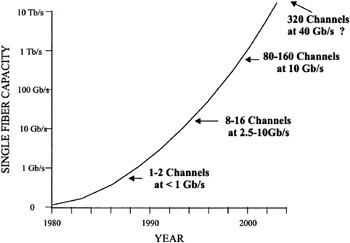
The preceding chapters laid a foundation for understanding individual optical fiber components and how they combine to make point-to-point systems. These discussions basically covered the progress of the technology from the 1970 s to the mid-1990 s. The systems analyzed in Chapter 7 were relatively uncomplicated, and the 2.5 Gb/s traffic capacity of the digital system was low by current standards. Figure 8 1 shows how progress in two key areas, TDM bit rates and DWDM channel spacing, have led to significant fiber capacity increases in the late 1990 s. An individual fiber now has the ability to handle an enormous amount of traffic, provided it has performance characteristics that support the advanced TDM/DWDM electronics/optics equipment. Impressive as these numbers are, for the near future the newest high-capacity systems will probably only be used on a small segment of the international/global network. A problem that affects the usage of new optical technology is a glut of installed fiber, brought about by the excesses of the dot.com bubble. Fortunately, the significant optical fiber technology gains generated in the boom years have laid a foundation for future growth. Internet (IP) traffic is still growing at about 50%/yr. It now accounts for a majority of the total traffic on the national network. As a result, the excesses of the boom years should be smoothed out relatively quickly.
For this Chapter, future is interpreted to mean the first decade of the new millennium. The period from the late 1990 s to 2003...