Optical Switching and Networking Handbook
The alternative for the carriers is DWDM. This increases the capacity of embedded fiber by first assigning incoming optical signals to specific frequencies within a designated frequency band and then multiplexing the resulting signals out onto one fiber. The technology that enables this high-speed, high-volume transmission is the optical amplifier. A network using such an amplifier could easily handle terabits of information.
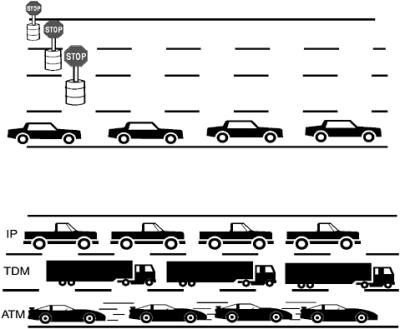
Think of a highway, where one fiber can be thought of as a multilane highway. Now let s think of only one lane open and barriers on the rest (like the barrels we are accustomed to seeing on highway systems). Traditional TDM systems use a single lane of this highway and increase capacity by moving faster on this single lane. Using DWDM is similar to opening up the unused lanes on the highway (increasing the number of wavelengths on the existing fiber) to gain access to an incredible amount of untapped capacity in the fiber. An additional benefit of optical networking is that the highway is blind to the type of traffic that travels on it. Consequently, the vehicles on the highway can be trucks (IP datagrams), tractor-trailers (SONET), or sports cars (ATM cells). This analogy is shown in Figure 7-3.
As the demand increases, the market share and the spending will not slow down for some time to come. In fact, spending in United States for SONET...