Plastic Piping Handbook

Source: National Transportation Safety Board
Special Investigation Report NTCB/SIR-98/01, Washington, D.C.
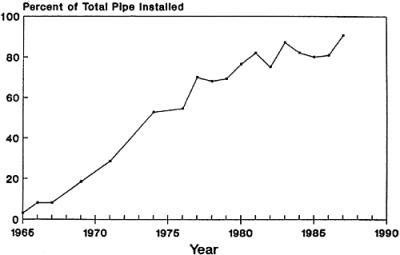
The use of plastic piping to transport natural gas has grown steadily over the years because of the material s economy, outstanding corrosion resistance, light weight, and ease of installing and joining. According to the American Gas Association (A.G.A.), the total miles of plastic piping in use in natural gas distribution systems in the United States grew from about 9,200 miles in 1965 to more than 45,800 miles in 1970 [1]. By 1982, this figure had grown to about 215,000 miles, of which more than 85 percent was polyethylene Data maintained by Office of Pipeline Safety (OPS), an office of the Research and Special Programs Administration (RSPA) within the U.S. Department of Transportation (DOT), indicate that, by the end of 1996, more than 500,000 miles of plastic piping had been installed [2]. Plastic piping as a percentage of all gas distribution piping installed each year has also grown steadily, as illustrated in Figure 13.1.
Despite the general acceptance of plastic piping as a safe and economical alternative to piping made of steel or other materials, the Safety Board notes that a number of pipeline accidents it has investigated have involved plastic piping that cracked in a brittle-like...