Polymer Nanocomposites: Processing, Characterization, and Applications

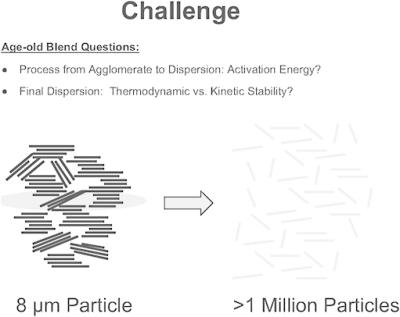
After the selection of a particular polymer matrix and the appropriate nanoparticles for a specific application, the next challenge is to determine the proper synthesis method to create the desired polymer nanocomposite. Figure 4.1 shows the processing challenge of transforming 8 ?m particles into > 1 million platelets. In general, for solid
thermosetting reactive prepolymers or thermoplastic polymers with solid nanoparticles, the following processing methods are recommended:
Solution intercalation
Melt intercalation
Roll milling
For liquid thermosetting reactive prepolymers or thermoplastic polymers with solid nanoparticles, the following processing methods are recommended:
In-situ polymerization
Emulsion polymerization
High-shear mixing
Examination of Figs. 4.2 and 4.3 identifies the real challenge that confronts the investigator as conditions are considered to suitably disperse the chosen polymer into the aggregated or layered nanoparticle(s). Solution intercalation, mesophase mediated (emulsion or suspension), in-situ polymerization, and melt processing are considered convenient methods to disperse layered silicates into nanocomposites in an intercalated or exfoliated state (Fig. 4.3). As it will be mentioned later, optimum mechanical properties of the resulting nanocomposite are obtained when the layered silicate is fully exfoliated with polymer inserted into the silicate galleries. Intercalation of layered silicate with polymer is somewhat beneficial in polymer properties enhancement but not as optimum as exfoliated systems.1 -9 An excellent review by Alexande and Dubois lists recent developments in synthesis, properties, and future applications of polymer-layered silicate...