Practical Foundation Engineering Handbook, Second Edition
RICHARD W. STEPHENSON
Rock consists of an aggregate of natural minerals joined by strong and permanent cohesive bonds. Rock mechanics is the engineering study of rock.
Soil is defined as natural materials consisting of individual mineral grains not joined by strong and permanent cohesive forces. Natural soils are products of the weathering of rock. Soil mechanics is the study of the engineering properties of soil.
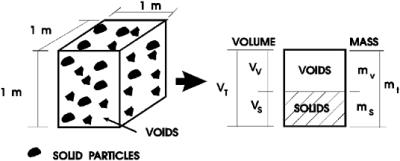
A natural soil consists of three separate components: solids, liquids, and gases. The solids are normally natural mineral grains, although they can be human-made materials such as furnace slag or mine tailings. The liquid is usually water, and the gas is usually air. The relative amounts of each of the components in a particular soil may be expressed as a series of ratios. These ratios may be based on relative masses or weights, relative volumes, or relative mass or weight densities. These weight volume ratios are fundamental to soil mechanics and geotechnical engineering.
If a soil consists of only solids (mineral particles) and voids (either gas- or liquid-filled), then it is a two-phase soil system. Although the void spaces are interspersed throughout the mineral particles, a unit volume of the soil may be viewed as in Fig. 2A.1. Using this figure, some terms can be defined. The unit weight of soil solids ( ? s) is