Prediction of Defects in Material Processing

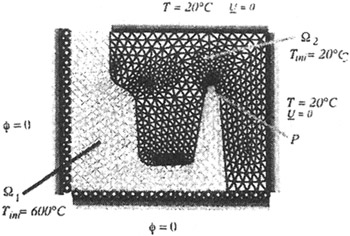
Let us consider the Finite Element model in Figure 1. 40 time steps are used to describe the evolution of the state variables. The two sub-domains ? 1 and ? 2 are elastic bodies, respectively in aluminium and sand. There is no initial gap between the two sub-domains. This is a plan strain problem.
The way ? 1 is cooled down depends on the contact conditions between the two sub-domains. Moreover these contact conditions are defined by the thermal expansion of each sub-domain. The thermo-mechanical coupling is strong and similar to the one encountered in casting problems.
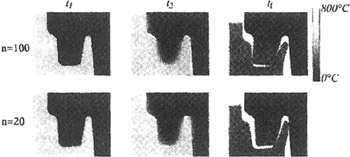
To forecast the defaults in a process with a simulation, it is interesting to obtain a quick overview of the evolution of the state variables. After 20 correction stages a good overview of the displacements and temperature fields is obtained (Figure 2).
Even accurate local results are quickly available, with few correction stages. In Figure 3 there is the example of the temperature evolution (Figure 1) on the point P obtained after different correction stages.
The LATIN subspace is very close to the subspace proposed by...