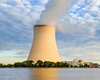
What is the difference between a fossil-fuel power plant and a nuclear power plant? In both types of plants, heat is used to produce steam in order to drive a turbine that turns a generator that, in turn, creates electricity. The basic difference between fossil-fuel power plants and nuclear power plants is the source of heat.
In a fossil-fuel power plant, coal, oil, or gas is burned in a furnace to heat water in a boiler in order to create steam. In nuclear plants no burning or combustion takes place. Nuclear fission is used, the fission reaction generates heat, and this heat is transferred, sometimes indirectly, to the water that provides the steam.
In a nuclear energy plant, the furnace is replaced by a reactor which contains a core of nuclear fuel consisting primarily of uranium. Energy is produced in the reactor by fission. A tiny particle, called a neutron, strikes the center or nucleus of a uranium atom, which splits into fragments releasing more neutrons. These fragments fly apart at great speed, generating heat as they collide with other atoms. The free neutrons collide with other uranium atoms causing a fission, which creates more neutrons that continue to split more atoms in a controlled chain reaction.
The chain fission reaction heats the water which moderates the reaction in the reactor creating steam, the force of which turns the turbine-generator. From this point on, nuclear energy plants operate essentially the same as fossil-fuel steam electric plants.
Power Plant Cycles
The...
Copyright The McGraw-Hill Companies, Inc. 2004 under license agreement with Books24x7


 TABLE OF CONTENTS