Radiation Physics of Metals and Its Applications
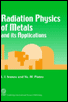
Written by pioneers of radiation materials science, this book discusses materials for atomic and thermonuclear reactors, and the development of new alloys.
In section 3.8, we examined in considerable detail the current general microscopic considerations regarding the processes of voids formation leading to an increase of the volume of irradiated metallic materials, i.e. swelling:
| (6.90) | 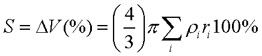 |
In this equation, ? i. and r i are the concentration and the radius of the i-population of the voids.
We analysed the possible mechanisms of the effect of dissolved elements on the nucleation and growth of voids in pure metals and solid solutions. In particular, special attention was given to investigating modelling representations regarding the effect of the diffusibility of point defects during their interaction with dissolved elements on the process of mutual recombination of point defects, vacancy super-saturation and the rate of nucleation of voids. Analysis was also carried out of the effect of segregations of dissolved elements on the dislocations and voids on the rate of nucleation and growth. However, in this case, the swelling resistance of specific steels and alloys was not investigated in relation to the chemical and phase composition.
In the present section, special attention is given to the analysis of the swelling of metallic materials for which the process is important in practice. They include, primarily, the materials of active zones of nuclear reactors, and also promising materials of the first wall and the blanket of fusion reactors, investigated at the present time. Altogether, these are austenitic and ferritic steels and also vanadium-based alloys. Special attention is given to the analysis of the swelling of...

 TABLE OF CONTENTS