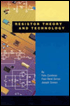
Resistor Theory and Technology

INTRODUCTION
In Part I we described in detail the physical principles relating the dependence of performance and the electrical and mechanical characteristics of resistive components to the materials and fabrication processes used in their production. Part II concerns the purely technological and practical aspects of these components. Using documentation provided by Vishay Intertechnology, Inc. and other manufacturers, we will provide an exhaustive examination of the criteria for selecting resistive components for use in specific applications.
While the information found in Part II is based on the theoretical foundation provided in Part I, this section of the book can be used independently. Those readers who would like a fuller understanding of the theoretical principles governing the design of a given component may wish to consult the corresponding chapter in Part I.
Chapter 7 introduces the terminology commonly used to describe the characteristics and performance of resistive components, fixed and variable (such as potentiometers and trimmers).
The chapters following describe in greater detail the manufacturing methods, materials used, and the expected performance of the above-mentioned and other (nonlinear and magnetoresistive) components. Using the theoretical developments of Part I as a base, the technological choices (materials, geometrical forms, processes, etc.) are examined in detail for...