Resistor Theory and Technology

Chapter 9: Power and Wirewound Resistors

1 INTRODUCTION

There are four principal types of wirewound resistors:

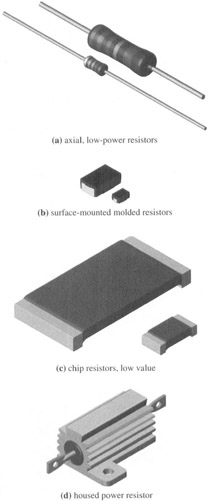
  • Axial or radial lead resistors (Fig. 1a)

  • Surface-mounted resistors (Figs. 1b, 1c)

  • Power resistors, still referred to as housed resistors (HR) (Fig. 1d)

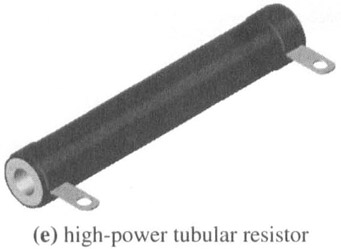
  • High-power tubular resistors (Fig. 1e)


Figure 1: Families of wirewound resistors

Figure 1: continued

Axial lead resistors consist of a winding of resistive wire on a cylindrical ceramic substrate. The current or voltage leads are made of metal wire (generally copper plated with a tin-lead alloy) welded at the ends of the cylinder to metal caps to which the ends of the resistive wire are also welded. Depending on the application, the leads are welded either axially (parallel to the axis of the cylinder) or radially (perpendicular to the axis of the cylinder). The body of the resistor is covered with a protective enamel or mineral-filled silicone coating.

Power resistors are made in the same way as radial lead resistors. However, they are then placed in a metal container that functions like a heat sink, and through which they dissipate a considerable amount of power.

Their range extends from a few ohms to approximately 10 4 ohms, with a TCR between 20 to 500 ppm/ C, depending primarily on ohmic value. Figure 1 presents some of the standard configurations and shapes for these types of resistors.

Nonwirewound high power surface-mounted resistors, specially designed in order to dissipate 2 to 5 times more electrical power than the HR type housed ones, are described in Section 5.

2 LOW-POWER...

UNLIMITED FREE
ACCESS
TO THE WORLD'S BEST IDEAS

SUBMIT
Already a GlobalSpec user? Log in.

This is embarrasing...

An error occurred while processing the form. Please try again in a few minutes.

Customize Your GlobalSpec Experience

Category: Shunt Resistors
Finish!
Privacy Policy

This is embarrasing...

An error occurred while processing the form. Please try again in a few minutes.