Rippling: Meta-level Guidance for Mathematical Reasoning

Chapter 3: Productive Use of Failure

The process of proving theorems generally involves many false starts, whether performed using paper and pencil, or with machine assistance. But failed attempts often provide insight on how to make progress. Andrew Wiles expressed this phenomenon succinctly with regard to the famous patch of his proof of Fermat s Last Theorem: Out of the ashes seemed to rise the true answer to the problem (BBC, 1996). Such insights are sometimes referred to as eureka steps and the informality and reflective nature of the associated discovery process is common to many, whether they are students studying logic or professional mathematicians like Andrew Wiles. For instance, it is often the case that analysis of a proof failure suggests a generalization of the original conjecture that can be proved more easily. What is less common, however, is to find a symbolic method of proof that directly promotes this discovery process. We show in this chapter how rippling provides a basis for such a method.

3.1 Eureka Steps

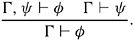
We begin by considering two of the key eureka steps that typically arise during the search for an inductive proof: conjecture generalization and lemma discovery. In terms of deduction, [1] both conjecture generalization and lemma discovery are underpinned by the cut rule of inference, which takes the form

We will make our usual assumption of a backwards style of proof construction. The cut rule allows us to exchange the goal of proving from ? for two new sub-goals: (a) proving

UNLIMITED FREE
ACCESS
TO THE WORLD'S BEST IDEAS

SUBMIT
Already a GlobalSpec user? Log in.

This is embarrasing...

An error occurred while processing the form. Please try again in a few minutes.

Customize Your GlobalSpec Experience

Category: Meter Provers and Flow Proving Components
Finish!
Privacy Policy

This is embarrasing...

An error occurred while processing the form. Please try again in a few minutes.