Service Assurance for Voice over WiFi and 3G Networks
There are many varieties of service models described in the literature. Each approach focuses on certain aspects of service management. We will first survey these approaches and discuss how they can be applied to solve service management problems. As this book focuses on assurance principles, our description of a service model is naturally biased toward solving the assurance problem. In this context, our survey of the literature is also related to service quality assurance.
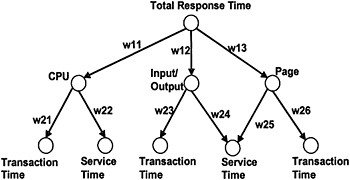
The measurement navigation graph (MNG) [1] model, first proposed by Hellerstein et al., is based on a directed, acyclic graph whose nodes are measurement variables. The goal of the MNG is to provide a framework for identifying performance problems. In the MNG, network measurements are represented by nodes, and the relationships between the measurements are indicated by directed arcs. An example of an MNG is shown in Figure 5.1.
In Figure 5.1, the service total response time (top node) depends on three measurements (second-level nodes): CPU response time, input/output (IO) response time, and paging response time. Each of these measurements further depends on lower-layer measurements (third-level nodes). Note that the service time that affects two parent measurements of IO and paging is a result of sharing resources between the user s IO and paging system IO.
To identify performance problems, the approach used in [2] is called quantitative performance diagnosis (QPD). QPD assigns weights (w s in the...