Sonet/SDH Demystified

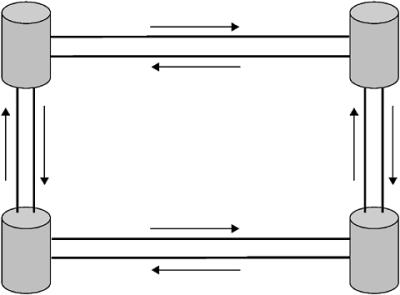
As we described earlier, ring architectures have several advantages. The first is the redundancy and survivability that the architecture provides. In a two-fiber implementation, shown in Figure 6-4, the rings are typically designated as a primary or active ring and a protect or backup ring. Live traffic is carried on the active path under normal operations, whereas the backup ring simply monitors the status of the overall system and transports keep-alive messages. In the event of a failure of the primary ring, automatic protection switching kicks in, causing the devices on either end of the ring breach to switch traffic (usually within 50 ms) to the backup span. Under normal circumstances, the user will be unaware of the switchover. This particular two-fiber architecture is known as a Unidirectional Path-Switched Ring (UPSR).
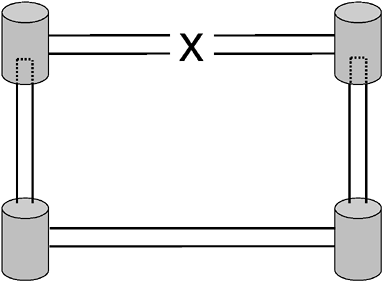
In the event of a dual-span failure (due to the efforts of our overly diligent backhoe driver described in Chapter 2), the ring wraps at the multiplexer nodes on either side of the breach, resulting in the creation of a single span ring, but preserving the integrity of the transmission path. This is shown in Figure 6-5.
Two-fiber rings can also be configured in such a way that active traffic travels on both rings simultaneously. This is known as a Bidirectional Line Switched Ring (BLSR). Let s assume that our ring is carrying 16 SONET STS or SDH STM channels. In a...