Spoken Language Processing

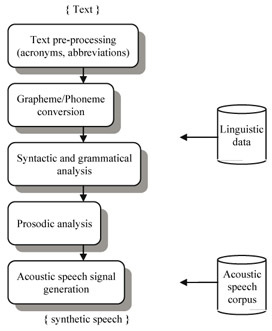
The most common model for describing a speech synthesis system, which also offers operational solutions, involves distinguishing between two main tasks: 1) the generation of a linguistic (phonetic and prosodic) description of the message; and 2) the generation of the corresponding synthetic signal (see Figure 3.1).
Such a model is advantageous, as it provides a very clear separation between, on the one hand, the universe of linguistic content and structure and, on the other hand, the synthetic speech signal itself, seen as a raw material which depends on the physiological characteristics of the speaker. This makes it possible, in the case of systems based on the concatenation of elementary acoustic units, to design efficient multilingual systems, because their linguistic aspects are easily interchangeable.
Linguistic processing aims at providing a pronounceable description of the message initially introduced in a text form to the synthesis system. Four key steps [4] can be distinguished: text pre-processing, grapheme-to-phoneme transcription, morpho-syntactic analysis and prosody generation.
Acoustic processing has two objectives:
firstly, to provide a speech signal whose phonetic content is in accordance with the message to be pronounced;
secondly, to generate a speech signal whose prosodic content corresponds to a possible utterance of the message to be pronounced. In most cases, three prosodic parameters are taken into account at the signal level: the duration, the pitch (for voiced...