- Chapter 1: COHERENT DIRECT-SEQUENCE SYSTEMS
- Chapter 2: NON-COHERENT FREQUENCY-HOPPED SYSTEMS
In its most general form a direct-sequence spread anti-jam communication system takes a binary data sequence and multiplies it by a higher rate pseudorandom (PN) binary sequence. The result is a binary sequence at the PN binary sequence rate which is then modulated. Compared to the usual modulation of the data, the data multiplied by the PN sequence causes the modulated signal spectrum to spread by a factor of N , the ratio of the PN sequence bit rate to the data bit rate. Such systems have been discussed in recent books and proceedings on spread-spectrum communications [1 ] [11 ] and in tutorial papers [12 ] [19 ]. Clark and Cain [9 ] provide the most complete discussion.
Figure 1.1 illustrates the general direct-sequence spread modulation. The data waveform is given by
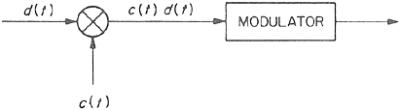 Figure 1.1: Direct-sequence modulation.
 | (1.1) | 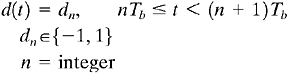 |
where { d n } is the data sequence. The PN binary waveform is
| (1.2) | 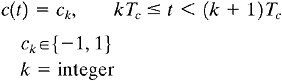 |
where { c k } is the PN sequence. Here,
| (1.3) |  |
is the signal spectrum-spreading factor. Typically, N is on the order of 1000 or more. T b is the bit time and T c is referred to as the chip time interval.
In the above multiplication of the data and the PN binary sequence, it is important that the data clock...
Copyright The McGraw-Hill Companies, Inc. 2002 under license agreement with Books24x7


 TABLE OF CONTENTS