Standard Handbook of Broadcast Engineering

Carl Bentz, K. Blair Benson
The first commercial satellite transmission occurred on July 10, 1962, when television pictures were beamed across the Atlantic Ocean through Telstar 1. The launch vehicle, however, lacked sufficient power to place the spacecraft into a stationary position. Three years later, after considerable progress in the development of rocket motors, INTELSAT saw its initial craft, Early Bird 1, launched into a geostationary orbit, and a rapidly growing communications industry was born. In the same year, the USSR inaugurated the Molnya series of satellites, which traveled in more elliptical orbits, to better meet the needs of that nation and its more northerly position. The Molnya satellites were placed in orbits inclined about 64 relative to the equator, with an orbital period half that of the earth.
From these humble beginnings, satellite-based audio, video, and data communications have emerged to become a powerful force in communications across all types of industries, from military logistics and support to consumer television.
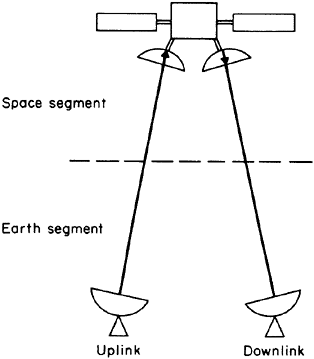
A satellite relay system involves three basic elements. On the ground is an up-link transmitter station, which beams signals to the satellite. The satellite, as the space segment of the system, receives, amplifies, and retransmits the signals back to earth. The down-link receiving station completes the system and with the up-link forms the earth segment. (See Figure 7.5.1.)