Switching Power Supply Design, 2nd Edition
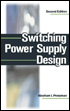
Mathematically sufficient without being unnecessarily academic, this practical book's tutorial, how-to approach shows how even a novice can immediately design a complete switching power supply circuit.
 TABLE OF CONTENTS
 The three earliest switching regulator topologies discussed in the previous chapter had the significant drawbacks that the output returns were DC-common with the input returns and that multiple outputs were not possible (except for the restricted case discussed in Sec. 1.3.8).
In this chapter, the most widely used switching regulator topologies are discussed. These topologies-the push-pull, single-ended forward converter, and two modifications of the latter, the double-ended and interleaved forward converter-have sufficient similarity to consider them as a family. All these topologies deliver their power to the loads via a transformer; hence output voltage returns are DC-isolated from input returns, and with multiple transformer secondaries, multiple DC output voltages are possible.
Push-pull topology is shown in Fig. 2.1. It consists of a transformer T1 with multiple secondaries. Each secondary supplies a pair of 180 out-of-phase square-wave power pulses whose amplitude is fixed by the number of secondary turns. Pulse widths at all secondaries are, of course, identical and are determined by the control circuit in the negative-feedback loop around a main secondary V m . That control circuit is basically much like that for the buck and boost regulators of Figs. 1.4 and 1.10 except that two equal and adjustable-width, 180 out-of-phase pulses are supplied to drive the bases of Q1, Q2 . Second-aries N s 1, N s 2 are referred to as "slaves."