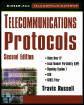
Telecommunications Protocols, Second Edition
The Big Picture of Telecommunications Networking - Today and Tomorrow
 TABLE OF CONTENTS
 Signaling System #7 (SS7) is the backbone of today's communications network. At the heart of every telephone company, long distance provider, and cellular provider is a network used by the providers' switching equipment to send control and signaling information between switches. This network is the communications network for communications equipment.
Signaling is certainly not new technology. In fact, signaling has been used in one form or another since the days of Alexander Graham Bell's first telephone device. The industry has refined signaling methods and since the digital revolution, has found new ways to communicate circuit- and network-related information over a separate network, SS7.
Today, the entire communications industry depends on the SS7 network. For example, making an 800 call would be difficult if not for the SS7 network. Remember that telephone switches route calls based on the digits dialed. The digits dialed represent an area, an office providing service in that area, and the subscriber's number. If we see the area code 212, most of us know that area code is for New York City. This analogy was recently made invalid with the FCC mandate for Local Number Portability.
The area code 800 can be used nationwide, and soon around the world. However, the area code 800 cannot be routed by telephone switches. The number must first be converted into a routing number that the telephone switches can understand. That is where SS7 comes in.
The telephone companies store these translation tables in databases...