Theory of Machines and Mechanisms, Third Edition

Chapter 23: Gyroscopes

23.1 INTRODUCTION

A gyroscope may be defined as a rigid body capable of three-dimensional rotation with high angular velocity about any axis that passes through a fixed point called the center, which may or may not be its center of mass. A child's toy top fits this definition and is a form of gyroscope; its fixed point is the point of contact of the top with the floor or table on which it spins.

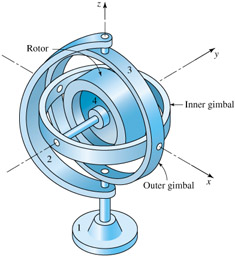
The usual form of a gyroscope is a mechanical device in which the essential part is a rotor having a heavy rim spinning at high speed about a fixed point on the rotor axis. The rotor is then mounted so as to turn freely about its center of mass by means of a double gimbals called a Cardan suspension; an example is pictured in Fig. 23.1.


Figure 23.1: A laboratory gyroscope.

The gyroscope has fascinated students of mechanics and applied mathematics for many years. In fact, once the rotor is set spinning, a gyroscope appears to act like a device possessing intelligence. If we attempt to move some of its parts, it seems not only to resist this motion but even to evade it. We shall see that it apparently fails to conform to the laws of static equilibrium and of gravitation.

The early history of the gyroscope is rather obscure. Probably the earliest gyroscope of the type now in use was constructed by Bohenburger in Germany in 1810. In 1852 Leon Foucault, of Paris, constructed...

UNLIMITED FREE
ACCESS
TO THE WORLD'S BEST IDEAS

SUBMIT
Already a GlobalSpec user? Log in.

This is embarrasing...

An error occurred while processing the form. Please try again in a few minutes.

Customize Your GlobalSpec Experience

Category: Gyroscopes
Finish!
Privacy Policy

This is embarrasing...

An error occurred while processing the form. Please try again in a few minutes.