Turbo-Machinery Dynamics: Design and Operation

Written by an author with more than three decades' experience in the field, this comprehensive text offers in-depth treatment of the fundamentals of thermodynamics and cycle design.
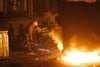
Combustion in gas turbines describes the exothermic reaction of a fuel and oxygen in the air. A flame propagating through the unburned charge of air and fuel, and defining a rapid chemical change occurring in a thin layer, accompanies the combustion process. The deflagration regime of combustion, requiring 1 10 -3 s to complete 80 percent of the task, is marked by a luminescent flame front that may be viewed as an interface between the burned gases and the unburned mixture. The process is characterized by steep temperature gradients and species concentration. Relative to the fresh air and fuel mixture, the burned gases are far higher in volume and temperature and lower in density, with the waves traveling at under 1 m/s. Instead of the flame (or combustion wave) spreading through a static gas mixture, it is usual to stabilize the flame to a steady condition by supplying it with a continuous flow of combustible mixture. In the detonation part of the combustion process, a shock wave connected with and supported by the chemical reaction zone propagates at velocities ranging between 1 and 4 km/s.
Both physical and chemical aspects are embraced during combustion. This subject of physics includes mass and heat transfer, thermodynamics, and gas and fluid dynamics; while chemistry influences pollutant emission among the products of combustion, the heat-release rate, and radiation properties of the flame at high temperatures. In aviation applications the chemical process also impacts lean light-off and flameout limits at high...

 TABLE OF CONTENTS