W-CDMA and cdma2000 for 3G Mobile Networks
Wireless Network Architecture

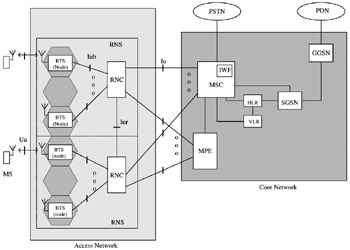
In many instances, standards documents describe protocols and interfaces at some well-defined reference points. A general network architecture with these reference points is shown in Figure 6-2. The network may be partitioned into two broad entities-the Universal Terrestrial Radio Access Network (UTRAN) and the core network. The UTRAN is responsible for establishing connections between UE and the rest of the network. A Radio Network Controller (RNC) is connected to one or more Base Transceiver Stations (BTS) or nodes, each of which serves a cell. The function of an RNC is to control radio resources. For example, it would assign frequencies, spreading and scrambling codes, the power levels of the various channels, and so on. The interface point between an RNC and a node is Iub. The user equipment accesses the UTRAN via the base station located in the serving cell.A Radio Network Subsystem (RNS), consisting of an RNC with its associated nodes, connects to the core network (CN) at a reference point Iu. Similarly, notice the interface point between two RNCs.An RNS is either the whole UTRAN, or only a part thereof that provides connections to a UE and includes only one RNC. For each UE connected to the network, only one RNS (called the serving RNS) controls the connections. However, other RNSs may assist the serving RNS as the mobile moves from one cell to another. Such an RNS is called a drift RNS.


Figure 6-2: A general UMTS...

UNLIMITED FREE
ACCESS
TO THE WORLD'S BEST IDEAS

SUBMIT
Already a GlobalSpec user? Log in.

This is embarrasing...

An error occurred while processing the form. Please try again in a few minutes.

Customize Your GlobalSpec Experience

Category: Network Equipment
Finish!
Privacy Policy

This is embarrasing...

An error occurred while processing the form. Please try again in a few minutes.