Water Quality and Treatment: A Handbook of Community Water Supplies, Fifth Edition

J.S.Taylor, Ph.D., P.E.
Alex Alexander Professor of Engineering
Civil and Environmental Engineering Department
University of Central Florida
Orlando, Florida
Mark Wiesner, Ph.D.
Professor of Engineering
Environmental Sciences and Engineering Department
Rice University
Houston, Texas
Membranes represent an important new set of processes for drinking water treatment. Their tremendous potential results from universal treatment capabilities and competitive cost. There are very few drinking water contaminants that cannot be removed economically by membrane processes, and several applications have been described in textbooks on water treatment (Weber, 1972; Belfort, 1984; Nalco, 1988). However, membrane processes with the greatest immediate application to potable water treatment are reverse osmosis (RO), nanofiltration (NF), electrodialysis (ED), ultrafiltration (UF), and microfiltration (MF).
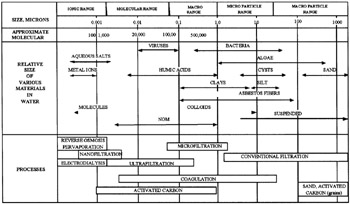
Reverse osmosis is primarily used to remove salts from brackish water or seawater, although RO is also capable of very high rejection of synthetic organic compounds (SOCs). Nanofiltration, the most recently developed membrane process, is used to soften fresh waters and remove disinfection by-product (DBP) precursors. Electrodialysis is used to demineralize brackish water and seawater and to soften fresh water. Ultrafiltration and microfiltration are used to remove turbidity, pathogens, and particles from fresh waters. In the broadest sense, a membrane the common element of all these processes could be defined as any barrier to the flow of suspended, colloidal, or dissolved species in any solvent. The applicable size ranges for membrane processes are shown in Figure 11.1.
Typically, the cost of membrane treatment increases as the size of...