Water Supply Systems Security

Walter M. Grayman, [*] Robert M. Clark, [ ] Benjamin L. Harding, [ ] Morris Maslia, [ ] and Jeff Aramini [ ]
[*]W. M. Grayman Consulting Engineer, Cincinnati, Ohio
[ ]Environmental Engineering and Public Health Consultant, Cincinnati, Ohio
[ ]Hydrosphere Resource Consultants, Inc., Boulder, Colorado
[ ]Agency for Toxic Substances and Disease Registry, Atlanta, Georgia
[ ]Health Canada, Guelph, Ontario
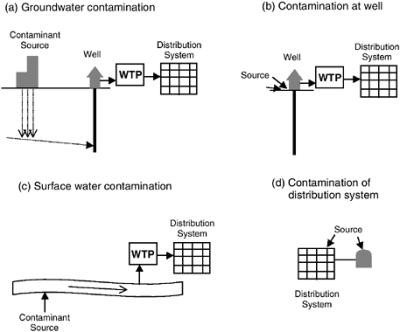
A water supply system is inherently quite susceptible to contamination. Contaminants may be introduced accidentally, naturally, or on purpose at a diverse range of locations in the large spatial extent of the system covering the source water, the treatment process, and the distribution system. Figure 10.1 illustrates a range of potential contamination scenarios.
Groundwater and surface water sources may be contaminated near to the entry point into the water system or at significant distances upstream or upgradient of the entry point. For surface water sources, the contaminant may move quickly with the flow and reach the intake in relatively short time spans. With a groundwater source, contaminant movement may take several years or even decades to travel to a well and may result in long-term contamination of the well or may be a short-term, immediate, and intense event if the contamination occurs at the well site.
Within the water treatment/distribution system, contamination can occur in a wide range of locations. Cross-connections between sewage systems and water systems, intrusion into pipes, contamination of storage facilities, and accidental or purposeful entry of contaminants through...