Wireless Networking: Know It All

Now that we are familiar with the various components used in constructing a radio, we can take a look at the overall problem of designing a radio for a given set of requirements.
Because of the half-duplex nature of a WLAN radio and the importance of component cost, it is generally the case that key choices in architecture are the same for transmit and receive. In a receiver, a key choice is the frequency of first conversion. The choice of the conversion frequency or frequencies, and the corresponding LO frequency or frequencies, is generally referred to as frequency planning. In a direct conversion architecture frequency planning is simple: there is no IF, and the LO frequency must equal the desired RF channel.
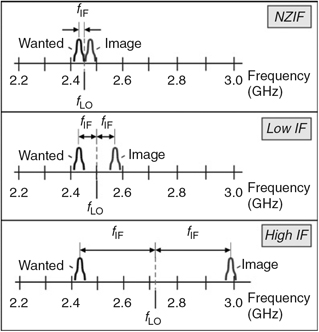
In a superhet design, there are several possible choices of IF (Figure 3.68). In an NZIF radio, the IF is chosen to be comparable with the bandwidth of the baseband signal, typically a few megahertz. Channel filtering is done at megahertz frequencies and can be accomplished with on-chip filters or inexpensive discrete components. However, the image frequency is very close to the wanted frequency and cannot be rejected by filtering. Instead, an IRM design must be used.
Low-IF designs, where the IF is typically chosen between a few 10s of MHz and 200 300 MHz, represent the classic approach to superhet radios. The band filter can filter the image frequency effectively if the IF is greater...