The Physics of Carbon Nanotube Devices

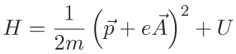
In the simplest, single-particle picture, the optical properties of carbon nanotubes can be understood by considering the Hamiltonian in the presence of optical radiation
| (7.1) | ![]() |
where
is the electron momentum, m its mass,
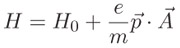
the magnetic vector potential of the impinging optical radiation and U includes all other interactions in the system. As long as the photon flux is not too large, the above Hamiltonian can be expanded to first order in the magnetic vector potential to give
| (7.2) | |
where H 0 is the Hamiltonian in the absence of light and where we have used the gauge
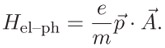
= 0. In this formalism the electron-photon interaction is considered a perturbation and is given by
| (7.3) | |
The magnetic vector potential for a monochromatic plane wave has the time and spatial dependence
| (7.4) | |
where is the direction of the light polarization, I is the photon flux and ? the optical frequency.
is the optical wavevector, oriented in the propagation direction, i.e. perpendicular to the electric and magnetic fields. To proceed further we consider the time-averaged transition probability between initial and final states within Fermi's golden rule
| (7.5) | |
The delta function in this equation indicates energy conservation; for band-to-band transitions due to optical absorption, this implies that an electron from the valence band is excited to the conduction band across the bandgap. To calculate the matrix elements we focus on two special cases corresponding to light polarized parallel...