

Announcements


Photo etched braze foil pre-forms offer numerous benefits over traditional braze and filler pastes or powders when used in vacuum and dip brazing applications in the aerospace industry.
(read more)
For designers and engineers working with precision metal components, understanding the capabilities of photochemical machining (PCM) is crucial for leveraging its full potential. Whether you’re exploring PCM for the first time or looking for the best service providers, having the right resources at your fingertips can streamline the process. This blog post highlights key sou...
(read more)
In the world of precision metal part manufacturing, choosing the right process can make the difference between success and frustration. Engineers and designers often default to conventional methods such as CNC machining, stamping, or laser cutting.
(read more)

Etched Surface Features Increase Thermal Capacity
(read more)
Photochemical machining is used to produce metal components for many types of aerospace applications from airframe stiffeners and heat sinks to satellite batteries.
(read more)
Find out why photo chemical machining is the process of choice in producing precision metal parts!
(read more)
Conard produces photo-etched copper and aluminum circuit board heatsinks for commercial and military applications.
(read more)
Conard has developed close working relationships with many other specialized metal processing businesses in New England and throughout the US. Conard provides parts processed through the assembly, sub-assembly, completed part or component stages.
Learn More
(read more)
Download the Comparing Technologies Guide
How Does Etching Compare to Stamping, Laser, Waterjet & Wire EDM?Learn the Surprising Results!
In a head-to-head comparison, photochemical machining is stacked up against more well known precision metal fabricating methods.
Details include:
- Tooling and set up
- Cycle times
- Unit costs and.../li>

Stamping shears metal. Laser and waterjet cutting leave heat-affected or ablative zones right along the edge. Both processes alter the material exactly where precision matters most.
Photochemical machining works differently.
A photoresist stencil defines the part, and the unwanted metal is dissolved away in a ferric chloride solution rather than sheared or burned off. Result: n...

Aluminum is one of the most useful metals in manufacturing, and one of the hardest to fabricate cleanly.
Plasma cutting runs around 25,000°F. EDM tops 15,000°F. Even laser, the "cool" option, hits about 5,500°F. All of it creates heat-affected zones that change the metal's properties right at the cut line. Try to control the fumes with a water table, and aluminum's react...

How PCM can Benefit Data Center Power Generation and Heat Reconversion
The rapid expansion of hyperscale and edge data centers—driven by AI, cloud computing, and digital infrastructure—has created a dual energy challenge: extremely high electricity demand and large volumes of low-grade waste heat. At the same time, distributed power generation and waste heat recovery t...
(read more)
PCM Removes Many Constraints to Flow Channel Designs
Engineers and designers developing advanced heat exchanger systems are under constant pressure to increase thermal performance, reduce size and weight, and improve manufacturability—of

Photo chemical machining (PCM), also known as chemical etching, continues to gain traction across many industries as engineers look for better ways to produce complex, high-precision metal components. In 2025, interest in PCM is being driven by miniaturization, faster product development cycles, and the need for stress-free fabrication. Below are the top ten frequently asked questions ab...
(read more)
Here are some things you can relate to:
- A credit card is about .020″ thick (twenty thousandths of an inch or ” 20 mils”)
- A human hair or a sheet of paper is about .005″ thick (five thousandths or 5 mils)
- Aluminum foil in your kitchen is about .001″ thick (one thousandth or 1 mil)
These dimensions are not small eno...
(read more)
In manufacturing, it's easy to stick to what you know. But for designers and engineers facing truly challenging fabrication problems, thinking beyond conventional methods is key.
At Conard Corp., we've seen countless projects where traditional stamping or laser cutting simply couldn't achieve the required precision or detail. That's where photochemical machining (PCM) comes in as an...

Modern solid modeling systems offer very direct paths for outputting data files for laser cutting (and its cousins: water jet and plasma), Wire EDM and even die design for both progressive and single strike die-stamping. But for sheet metal fabricating’s “best-kept secret,” CAD consideration for photo chemical machining (PCM) is an afterthought.
PCM, though, offe...
(read more)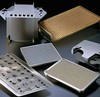
The Benefits of Photo Chemical Machining for Metal Filtration Devices
Metal filtration devices play a crucial role in industries ranging from aerospace and automotive to medical, chemical processing, and energy production. These components often require intricate, high-precision perforations and complex geometries to meet functional and performance demands. For manufacturer...
(read more)
The Benefits of Photo Etching for Super-Critical CO₂ Stirling Engine Designs
sCO₂ Stirling engines operate under extreme conditions to maximize energy extraction from a given heat source. This requires components like heat exchangers, regenerator plates, flow channels, and seals to be manufactured with exacting precision. Photo etching excels in producing highly...
(read more)
Fuel cells, microturbines and batteries use chemically etched components in a number of ways:
- proton exchange membranes
- fuel plates and flow channels
- heat exchangers
- air bearings
- anode grids
Renewable energy and distributed generation are changing the playing field for electrical power. Solar, wind and hydro power are...
(read more)
- Precision and Accuracy: Photo chemical machining allows for precise and accurate metal fabrication, enabling the creation of intricate and complex designs with dimensional tolerances of +/-15% of metal thickness and feature locations within .001”. Learn more about design for etching here.
- Cost-Effectiveness: Etching is cost-effective for producti...

As the global transition to electric vehicles (EVs) accelerates, the demand for innovative manufacturing techniques that enhance efficiency, performance, and sustainability is rapidly increasing. One such technology gaining prominence in EV battery applications is photo etching, also known as chemical etching. This precise, cost-effective, and versatile process offers a range of advantag...
(read more)
When Conventional Processes Don’t Fit The Bill… Photo chemical machining (PCM), also known as photo etching or chemical etching, is a powerful subtractive manufacturing process ideal for producing intricate metal parts with tight tolerances and complex geometries. It offers several advantages—such as stress-free processing, no burrs, and the ability to handle high-pre...
(read more)
Small is Big
In most industries, there is a strong demand for precision metal parts. In many cases, these parts also have to be brought down to the micro level - with features that are a few thousandths of an inch. Photo etching has a number of process capabilities that make it a desirable fabrication method for these purposes.
One hole or a million- they are all free!
(read more)
Design for Manufacturability (DFM) in Photo Chemical Machining: A Guide for Engineers and Designers
In the world of precision metal components, achieving intricate designs with tight tolerances can be a challenge. Photo Chemical Machining (PCM) offers a unique manufacturing process that eliminates mechanical stress, enabling the production of complex parts with high...
(read more)
How Photo Etching is a Capable Alternative to Other Metal Fabricating Processes
(read more)
Photochemical machining is used to produce metal components for many types of aerospace applications from airframe stiffeners and heat sinks to satellite batteries.
The ability to produce complex parts that are free of burrs and thermal or mechanical distortion in very thin gauges of metal is a key advantage of chemical etching. Precision etched components enable the creation of c...
(read more)
The biggest design problem is that the design requirements for photo etching are not widely understood. The five most common etching design problems are:
1. Choosing metal that is thicker than need
Specifying material thickness in excess of what the application requires. It is not uncommon to see drawings asking for much heavier gauges of metal than the part's function may...
(read more)
- A means of photofabricating thin gauge precision metal parts
- Metal thickness ranges from .001″ to .080″ depending on the type of metal
- Etchable Metals include many alloys of steel, copper, aluminum, molybdenum and more. More Etchable Alloys
- Alternative to stamping, punching, laser, water jet and wire EDM
- Low cost tooling in one...

When Photo Chemical Machining is Superior to Stamping, Laser Cutting, and Wire EDM
Photo Chemical Machining (PCM), also known as photo etching, is a highly precise, versatile metal fabrication process that offers significant advantages over traditional manufacturing methods like stamping, laser cutting, and wire Electrical Discharge Machining (EDM). While each of these tech...
(read more)
Here’s a detailed explanation of how etching solution temperature, spray bar pressure, and oxidation-reduction potential (ORP) influence accuracy and consistency in photo chemical machining (PCM):
Impact of Etching Solution Temperature
The temperature of the etching solution plays a critical role in determining the rate and uniformity of material remova...
(read more)
What is Photo Chemical Machining?
Before diving into its applications, it's important to briefly understand the PCM process. PCM involves coating a metal sheet with a photoresist, which is then exposed to UV light through a photomask with the desired design. The exposed areas act as a stencil to protect parts of the metal during the chemical etching stage. Once etched, the...
(read more)
Photo etched braze foil pre-forms offer numerous benefits over traditional braze and filler pastes or powders when used in vacuum and dip brazing applications in the aerospace industry. Aerospace components demand high precision, strength, and reliability, which makes the choice of brazing materials and techniques crucial. The advantages of using photo etched braze foil pre-forms include...
(read more)
Precision photo chemical etching is characterized by detailed specifications that call for conformance to identified dimensions, tolerances and inspection requirements. These factors have implications with regard to pricing. By contrast, decorative etching is all about appearance and as such, we are able to run decorative on large sheets with minimal inspectio...
(read more)
The Photo Chemical Machining Institute (PCMI.org) is the global trade association for the companies that produce photo etched precision metal components. In its standard verbiage, it states that minimum dimensional tolerances can be as tight as +/- 10% of metal thickness.
That's somewhat true, but they don't explain what consequences that choice can entail. A while back, we did a...
(read more)
A Fascinating Non-Conventional Metal Fabricating Option
Photo etching, also known as photochemical machining or chemical milling, is a fascinating process that lies at the intersection of science and art. It's a technique used in various industries, from aerospace to electronics, to create intricate metal parts with remarkable precision. In this blog post, we'll delve into the sci...
(read more)
Believe it or not, the EV Age started with rudimentary electric carts in the 1820s...
It was a tinker's world. People cobbled together ways of mechanizing movement using primary batteries (non-rechargeable) and whatever they could find for electric motors.
By the mid-19th century, patents had issued in the US and Europe for electrified rails as conductors of current. Power...
(read more)
Photo chemical machining, or photo etching, is a fabrication process used in the creation of precision metal parts. Often, it is used as an alternative to conventional processes like stamping, punching, wire EDM, laser cutting and other common machining methods. Currently, photo chemically machined parts are used in a variety of industries, ranging from microelectronics to medical device...
(read more)
Photo etching is an effective solution for producing precision parts that are used in sensing, detecting and measuring applications. These types of components interact mechanically with “the outside world” and electrically with the system or device to which they “report”.
(read more)
Many engineers and designers have embraced photo etching, also known as chemical etching or photochemical machining, as their go-to option for making metal filtration, grids and screens.
Some of the benefits of etching include:
Precision and Accuracy:
Photo etching allows for high precision and accuracy in creating patterns and designs on metal surfaces. This is cruc...
(read more)
A "Multi-Tool" for Metal Fabricating
Modern solid modeling systems give engineers and designers of precision metal components a wide variety of options for fabricating their creations, whether it be stamping, punching, or digital cutting via laser, plasma or waterjet. However, none of these software platforms has any information at all about photo chemical machining.
We
(read more)

Photochemical etching is an ideal process for perforated metal products.
(read more)
Find out why photo chemical machining is the process of choice in producing precision metal parts!
The photo chemical machining process is a means of fabricating thin gauge metal parts. Applications for etched components range from aerospace, medical, and electronics, to Christmas tree ornaments and scale models or railroads, villages, and ships.
In this guide, you will learn:

Photochemical machining is used to produce metal components for many types of aerospace applications from airframe stiffeners and heat sinks to satellite batteries.
The ability to produce complex parts that are free of burrs and thermal or mechanical distortion in very thin gauges of metal is a key advantage of chemical etching. Precision etched components enable the creation of c...
(read more)