
Converting Services Information
Converting services cut, join, finish, package, and assemble units of material into more usable shapes and size s. For example, converting services that work with textile manufacturers cut large rolls of fabric into smaller webs or individual sheets. Converting may also involve the process of transforming a general product into something more specific.
Types of Services
Converting service companies may convert materials and create products using a number of machining and fabrication methods. When distinguishing between converting services, it is important to understand these different processes.
Assembly involves putting final materials and components together into a finished product.
Coating is applying a material, which is converted to a solid protective, or functional adherent film after application as a thin layer.
Cutting involves making slices or cuts in a material for division and shaping. Cutting methods include waterjet, pressure, hot wire, and laser.
Die cutting produces loose pieces of material cut to a variety of shapes and sizes using steel rule and rotary dies. Close tolerance is achieved cut after cut as the accuracy is built into the die.
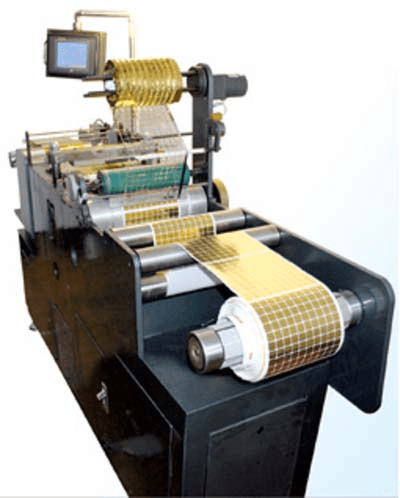
Die cutting machine. Image Credit: Die Cutting Solutions, Inc.
Edge conditioning includes cambering, sealing, skiving, and trimming. Cambering is an edge curving process. Skiving is filing the edge of a material. Trimming is a process where material is cut down to the desired size or shape.
Flattening is a leveling operation of material through a unit housing a series of small diameter rolls.

Mesh flattening machine. Image Credit: Kanwal Enterprises
Finishing capabilities include calendering, polishing or grinding, sizing, and sealing. Calendering is the process of forming thermoplastic sheeting by squeezing heated, viscous material between two or more counter-rotating rolls. Polishing is the smoothing of metal surfaces or rubbing them to a high luster with a fine abrasive. Grinding is a process by which particles are reduced in size mechanically. Sizing is the surface treatment applied to glass fibers used in reinforced plastics
Heat sealing is the process of joining two or more thermoplastic films or sheets by heating areas in contact with each other to the temperature at which fusion occurs, usually aided by pressure.
Laminating is the joining two or more layers, up to 48" wide, of foams, films, paper or foil, using pressure-sensitive adhesive products.
Laminating machine. Video Credit: ulampshades (Youtube)/ CC BY-SA 4.0
Packaging includes the assembly of finished product into containers. Labeling and printing may also be included.
Printing is the transfer of ink onto paper or other materials to reproduce words and images. Methods include flexographic, impact and non-impact.
Sheeting is the reduction of stock in continuous rolls to individual sheets of required length.
Slitting is rewind or baloney slitting to your specified widths. A variety of materials, both adhesive backed and non-adhesive backed, may be slit to width.
Spooling is a winding process that transfers long lengths of material to a spool.

Double wire spooling machine. Image Credit: Ernst Pfäffle
Rewinders rewind the roll off the original winder. Because it is difficult to retain perfect consistency of thickness and grain when the sheet is being wound directly off the machine onto the first winder, rewinding the sheet can help even out stretches and crooked sheets and other imperfections.
Materials
Converting services handle a variety of materials, ranging from ceramics and glass to laminates and composites. Some companies specialize in working with foam and porous materials, while others handle metal, paper and paperboard, rubber and elastomer, stone and masonry, or wood and natural fibers. When selecting a converting service company, finding one that works with the right materials is fundamentally important.
Capabilities
Converting services vary in terms of the capabilities they provide, specifically the types of shapes and products they are able to make and prepare. The range of products converting services may produce is large, so it is important to find a service that satisfies the user's particular needs.
- Adhesives and tape
- Building materials
- Coated abrasives and jumbos
- EMI and RFI shielding
- Insulation
- Masks and masking
- Seals and gasketing
- Sheet and film
- Stock shapes
- Wire and filament
- Wire cloth and screen
Capabilities also include the dimensions of the converted products. Converting service companies have limits on the size of products they can make, typically based on the capabilities of the equipment and machinery used. Depending on the shape, size limits may be specified in dimensions of width, thickness, and/or outer diameter. Measurements are commonly expressed in feet and inches or meters and centimeters.
Location
As with most service companies, location is an important selection factor to consider. Companies located farther away from the client may be more expensive to utilize due to the shipping costs of materials and final products. There may also be additional complications when dealing with companies from different countries and oversea locations.
Image credit:
W.S. Hampshire
- Alabama
- Arizona
- California
- Colorado
- Connecticut
- Delaware
- Florida
- Georgia
- Iowa
- Illinois
- Indiana
- Kansas
- Kentucky
- Massachusetts
- Maryland
- Maine
- Michigan
- Minnesota
- Missouri
- North Carolina
- New Hampshire
- New Jersey
- New York
- Ohio
- Oklahoma
- Oregon
- Pennsylvania
- Rhode Island
- South Carolina
- Tennessee
- Texas
- Virginia
- Vermont
- Washington
- Wisconsin
- West Virginia
- Adhesives / Tape
- Assembly
- Building Materials
- Ceramic / Glass
- Coated Abrasives / Jumbos
- Coating
- Cutting
- Die Cutting
- EMI / RFI Shielding
- East Asia / Pacific Only
- Edge Conditioning
- Finishing
- Flattening / Straightening
- Foam / Porous Materials
- Heat Sealing
- Insulation
- Laminate / Composite
- Laminating
- Masks / Masking
- Metal
- Midwest US Only
- North America
- Northeast US Only
- Northwest US Only
- Packaging
- Paper / Paperboard
- Plastic
- Printing
- Rewinding
- Rubber / Elastomer
- Seals / Gasketing
- Sheet / Film
- Sheeting
- Slitting
- Southern US Only
- Southwest US Only
- Capabilities: Specialty / Other
- Materials: Specialty / Other
- Services: Specialty / Other
- Spooling
- Stock Shapes
- Textile / Fabrics
- United States Only
- Wire Cloth / Screen
- Wood / Natural Fibers