Caring for the Customer, Fourth Edition

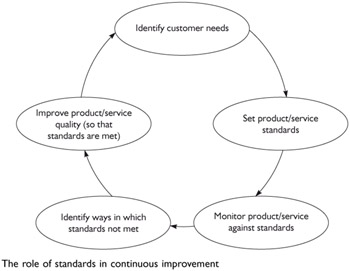
An important principle to bear in mind when setting standards is that you first need to establish what the needs of your customers are. Secondly, standardsetting should not be a one-off task. Rather, you should see it as part of a cycle of continuous improvement in which the meeting of standards leads to greater expectations on the part of customers, which in turn lead to higher standards being set and the quality of the product or service being improved further.

Let's consider one simple example. You may remember that the Patient's Charter was referred to in Session A. One of the standards in the Charter was that all patients attending an outpatient clinic should be seen within 30 minutes of their appointment time. Suppose that the Ear, Nose and Throat Clinic of your local hospital succeeded in reaching this standard. To improve the quality of its service it would then have to review the standard and perhaps rewrite it as 'All patients to be seen within 20 minutes of their appointment time'.
It's important to word standards in a way that makes them totally unambiguous. Suppose, for example, that the manager of the local authority Publications Department, discussed in Section 2, wrote the following standard:
All queries about progress on jobs to be answered quickly.
This immediately raises the question of what is meant by 'quickly'. Does it mean within five minutes, within one hour, or even within 24 hours? The standard...