Foundation Engineering Handbook: Design and Construction with the 2006 International Building Code
A retaining wall is defined as a structure whose primary purpose is to provide lateral support for soil or rock. In some cases, the retaining wall may also support vertical loads. Examples include basement walls and certain types of bridge abutments.
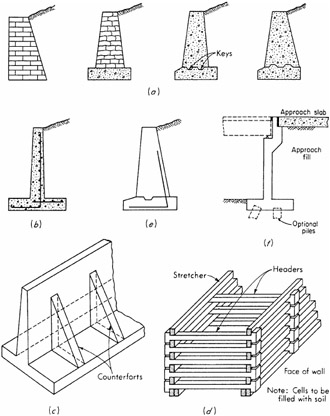
Some of the more common types of retaining walls are gravity walls, counterfort walls, cantilevered walls, and crib walls. Gravity retaining walls are routinely built of plane concrete or stone and the wall depends primarily on its massive weight to resist failure from overturning and sliding. Counterfort walls consist of a footing, a wall stem, and intermittent vertical ribs (called counterforts) that tie the footing and wall stem together. Crib walls consist of interlocking concrete members that form cells, which are then filled with compacted soil. Common types of retaining walls are shown in Fig. 11.1.
Although mechanically stabilized earth retaining walls have become more popular in the past decade, cantilever retaining walls are still probably the most common type of retaining structure. There...