Foundation Engineering Handbook: Design and Construction with the 2006 International Building Code
Chapters 5 through 14 (Part 2 of the book) have dealt with the geotechnical aspects of foundation engineering design. Part 3 of the book (Chaps. 15 to 17) deals with foundation construction and includes such topics as grading, soil improvement, foundation excavations, foundation underpinning, field load-testing of foundations, geosynthetics, and instrumentation.
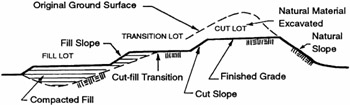
Since most building sites start out as raw land, the first step in site construction work usually involves the grading of the site. Grading basically consists of the cutting or filling of the ground in order to create a level building pad upon which the foundation and structure can be built. The three types of level building pads that are created by the grading operations are cut lots, cut-fill transition lots, and fill lots as illustrated in Fig. 15.1. Appendix A (Glossary 4) presents a list of common grading terms and their definitions.
The typical steps in a grading operation are as follows:
Easements. The first step in the grading operation is to determine the location of any on-site utilities and easements. The on-site utilities and easements often need protection so that they are not damaged during the grading operation.
Clearing, brushing, and grubbing. Clearing, brushing, and grubbing are defined as the removal of...