Foundation Engineering Handbook: Design and Construction with the 2006 International Building Code
Chapter 6: Bearing Capacity of Foundations

6.1 INTRODUCTION

A bearing capacity failure is defined as a foundation failure that occurs when the shear stresses in the soil exceed the shear strength of the soil. Bearing capacity failures of foundations can be grouped into three categories, as follows (Vesi?, 1963, 1975):

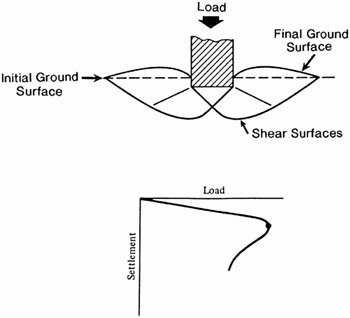
  1. General shear. As shown in Fig. 6.1, a general shear failure involves total rupture of the underlying soil. There is a continuous shear failure of the soil (solid lines) from below the footing to the ground surface. When the load is plotted versus settlement of the footing, there is a distinct load at which the foundation fails (solid circle), and this is designated Q ult. The value of Q ult divided by the width B and length L of the footing is considered to be the ultimate bearing capacity ( q ult) of the footing. The ultimate bearing capacity has been defined as the bearing stress that causes a sudden catastrophic failure of the foundation (Lambe and Whitman, 1969).


Figure 6.1: General shear foundation failure. ( After Vesi?, 1963.)

As shown in Fig. 6.1, a general shear failure ruptures and pushes up the soil on both sides of the footing. For actual failures in the field, the soil is often pushed up on only one side of the footing with subsequent tilting of the structure. A general shear failure occurs for soils that are in a dense or hard state.

  1. Local shear failure. As shown in Fig.

UNLIMITED FREE
ACCESS
TO THE WORLD'S BEST IDEAS

SUBMIT
Already a GlobalSpec user? Log in.

This is embarrasing...

An error occurred while processing the form. Please try again in a few minutes.

Customize Your GlobalSpec Experience

Category: Concrete Construction and Foundation Services
Finish!
Privacy Policy

This is embarrasing...

An error occurred while processing the form. Please try again in a few minutes.