Free-Space Optics: Propagation and Communication

The phenomena that surround us are, for the most part, continuous phenomena. They are quantifiable; they pass from one value to another without interruption. When you wish to restore or reproduce these values, it is necessary, first, to make a recording on a physical medium. When the physical medium can take continuous values, this is called analogue recording. For example a video cassette, an audio cassette or a disc vinyl are analogue media; but their frequent or prolonged use involves eventual deterioration of the medium and thus of the recording.
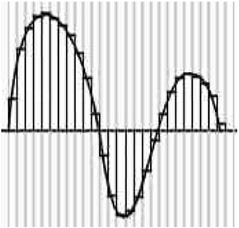
A solution to this problem is to proceed with the digitization of the signal to be reproduced, i.e. "to cut out" these continuous phenomena in the smallest "pieces" possible, in order to "transform" the continuous signal into a succession of "bricks" more or less the same "height". The example in Figure 6.1 below represents the principle of digitization.
Digitization consists in "replacing" the analogue signal (the black curve), by "a brick" succession in which the height (i.e. the amplitude) is digitized (the black histogram). The transformation of an analogue signal into a numerical, or digital, signal is called digitization or sampling. Sampling consists of periodically taking samples of a signal. The numerical signal quality will depend on two factors:
the sampling frequency (called sampling rate): the larger the sampling frequency (i.e. the samples are picked up at smaller intervals of time), the closer the numerical signal will be to the...