High Definition Audio for the Digital Home: Proven Techniques for Getting It Right the First Time

Those parts of the system that you can hit with a hammer (not advised) are called hardware; those program instructions that you can only curse at are called software.
Unknown
This chapter introduces the information needed to understand the hardware components that make up an audio subsystem in a modern PC, after the shift to chipset-based audio. It also addresses the attributes and constraints of several key hardware components such as converters and analog amplifiers. Finally, the Intel High Definition Audio interface is introduced and explored in some detail.
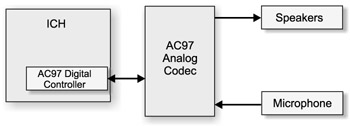
In 2004, Intel announced an Audio Codec 97 (AC97) replacement known as Intel High Definition Audio (Intel HD Audio). Introduced in 1997, the AC97 standard allowed sound-processing tasks such as sample rate conversion and mixing to be handled by the CPU. Logic known as the AC97 digital controller was added to the Southbridge or ICH chipset, as shown in Figure 4.1.
AC97 was originally known as soft audio or host audio because it off-loaded many of the sound-processing tasks from dedicated hardware to software that is run on the general purpose CPU. Intel HD Audio is thematically similar to AC97 but includes support for many new features. For instance, Intel HD Audio can support 32-bit, 192-kilohertz surround sound out as well as multi-tasking, which is the ability to support multiple audio inputs and outputs simultaneously.
Quite a bit of the AC97 infrastructure is retained...