High Definition Audio for the Digital Home: Proven Techniques for Getting It Right the First Time

Link

The link itself, which connects a controller with one or more codecs, is a physical electrical interface consisting of the BCLK, SYNC, and RST# signals. It also consists of one to four SDO signals, denoted SDO 0-SDO 3 respectively, and one to fifteen SDI signals, and denoted SDI 0-SDI N respectively.

Topology

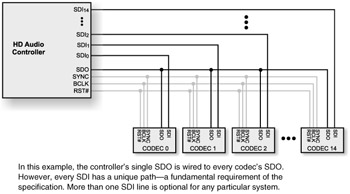
The SDO lines can be multipoint; that is, a single SDO line can be attached to multiple codecs. In a configuration like the one in Figure 4.4, multiple codecs could receive the same audio data, thus allowing, for instance, a set of headphones and separate stereo speakers to receive the same program. However, the same physical topology could be used to send different programs to the headphones and speakers. The data sent from the controller can be targeted at a specific codec.


Figure 4.4: Sample Link Topology

Unlike SDO, the SDI lines are point-to-point. Each attached codec's SDI must be wired to a unique SDI n on the controller. Given that each codec must have at least one SDI, a practical upshot of these constraints is that the maximum number of codecs that can be attached to a particular link is limited by the number of SDIs the controller supports.

Most, if not all, Southbridge chipsets that incorporate Intel HD Audio have at least four SDI pins, allowing up to four Intel HD Audio devices to be used in a system. The SDI pin that the codec is attached to determines the...

UNLIMITED FREE
ACCESS
TO THE WORLD'S BEST IDEAS

SUBMIT
Already a GlobalSpec user? Log in.

This is embarrasing...

An error occurred while processing the form. Please try again in a few minutes.

Customize Your GlobalSpec Experience

Category: Audio Headphones
Finish!
Privacy Policy

This is embarrasing...

An error occurred while processing the form. Please try again in a few minutes.