High Definition Audio for the Digital Home: Proven Techniques for Getting It Right the First Time

Controller

An Intel HD Audio controller provides a capability for the system to discover and enumerate multiple Intel HD Audio devices connected to the Intel HD Audio link. It provides a capability to relay instructions to and from each codec, and it contains the Direct Memory Access (DMA) engines which stream audio data to and from the codec(s).

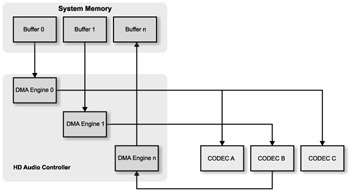
An Intel HD Audio Controller usually contains four or more DMA engines. DMA refers to copying data from one memory location to another without having to go through the CPU. In this case, the transfer goes from system memory to a codec or goes from a codec to system memory (see Figure 4.3). DMA transfers are faster than non-DMA transfers.


Figure 4.3: Controller DMA Engines

A DMA transfer from system memory to a codec is handled by a signal known as Serial Digital Out (SDO). DMA transfers in the opposite direction are handled by a Serial Digital In (SDI) signal. Controllers must provide support for at least one SDO line, up to a maximum of four, and at least one SDI line, up to a maximum of fifteen. The SDO and SDI lines are used to carry both commands and audio sample data, as explained in more detail in the "Command and Data Flow" section. In addition to the SDO and SDI lines, the controller must support bit clock (BCLK), frame synchronization (SYNC), and reset (RST#) signals.

The controller also contains a standardized set of memory-mapped registers that allow for command and...

UNLIMITED FREE
ACCESS
TO THE WORLD'S BEST IDEAS

SUBMIT
Already a GlobalSpec user? Log in.

This is embarrasing...

An error occurred while processing the form. Please try again in a few minutes.

Customize Your GlobalSpec Experience

Category: Codec ICs
Finish!
Privacy Policy

This is embarrasing...

An error occurred while processing the form. Please try again in a few minutes.