LabVIEW based Advanced Instrumentation Systems
Learning Objectives. On completion of this chapter the reader will have a knowledge on:
Current Trends in Instrumentation
Fiber Optic Instrumentation
Fiber Optic Sensors such as Pressure Sensors, Voltage Sensor, Liquid Level Monitoring, Temperature Sensors, Stress Sensor
Fiber Optic Gyroscope Polarization Maintaining
Advantages of Fiber Optics
LASER Instrumentation
Measurement of Velocity, Distance and Length using LASER
LASER Heating, Welding, Melting and Trimming
LASER Trimming and Melting
Smart Intelligent Transducers
Smart Transmitter with HART Communicator
Computer Aided Software Engineering (CASE)
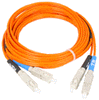
Fiber-optic strands provide a significant advantage over standard copper transmission lines. The potential information-carrying capacity of a single fiber strand is much greater than a single copper wire. The carrier frequencies used in light waveguides are far greater than those deployed in copper lines; light is composed of different wavelengths each of which can carry a separate data channel. This section describes the fiber-optic sensors used in applications such as pressure measurement, voltage measurement, liquid level monitoring, temperature measurement, and stress analysis. The concepts of LASER instrumentation are also discussed in this chapter, which focuses on LASER trimming, welding and heating. The later sections of this chapter deal with the most recent developments in instrumentation such as Smart Transmitters and Use of CASE tools in Instrumentation.
Optical fiber is the workhorse of any optical communication system. It is basically the conduit for the data and ends up linking all of the...