LabVIEW based Advanced Instrumentation Systems
This application aims to create large-area extensive air shower (EAS) detector array for ultra-high energy (UHE) cosmic rays, by installing mini-arrays of scintillation counter detectors in secondary schools, in the Seattle, WA area. Data taken at individual school sites are shared via Internet connections and searched for multisite coincidence events. WALTA collaborated with CROP, a similar project based at the University of Nebraska at Lincoln, to salvage plastic scintillators, photomultiplier tubes (PMTs) and associated high voltage supplies from surplus equipment at the CASA detector site at Dugway, UT.
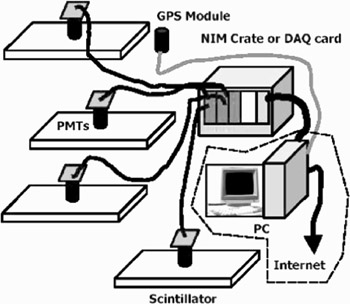
Individual detector stations each consist of four scintillation counter modules, front-end electronics, and a GPS receiver, as shown in Fig. 11.51. Preliminary training of secondary school teachers and users was conducted using obsolete NIM crates and fast electronics (discriminators, coincidence, and sealer modules) loaned from Fermilab. These modules are now being replaced by the new DAQ cards, which add GPS timing and a simple RS232 computer interface. The QuarkNet DAQ card provides a low-cost alternative to standard particle and nuclear physics fast pulse electronics modules.
The board, which can be produced at a cost of less than US$500, produces trigger time and pulse edge time data for 2 to 4-fold coincidence levels, via a universal RS232 serial port interface, usable with any PC. Details of the DAQ card have been presented elsewhere. The DAQ cards produce...