Microvias: For Low Cost, High Density Interconnects

2.6: Machining and Routing

2.6 Machining and Routing

Laminate machining consists of the mechanical processes by which circuit boards are prepared for the vital chemical processes of image transfer, plating, and etching. Such processes as cutting to size, drilling holes, and shaping have major effects on the final quality of the printed board. This section will review the basic mechanical processes that are essential to producing the finished board.

2.6.1 Punching holes (piercing)

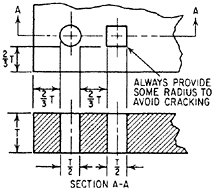
Design of the die.

It is possible to pierce holes down to one-half the thickness of XXXPC and FR-2 laminates and one-third that of FR- 3 (Fig. 2.30). Many die designers lose sight of the fact that the force required to withdraw piercing punches is of the same magnitude as that required to push the punches through the material. For that reason, the question of how much stripper-spring pressure to design into a die is answered by most toolmakers: as much as possible. When space on the dies cannot accommodate enough mechanical springs to do the job, a hydraulic mechanism can be used. Springs should be so located that the part is stripped evenly. If the board is ejected from the die unevenly, cracks around holes are almost certain to occur. The best-quality holes are produced when the stripper compresses the board an instant before the perforators start to penetrate. If the stripper pressure can be made to approach the compressive strength of the material, less force will be required and the holes will be cleaner.


Figure 2.30: Proper sizing...

UNLIMITED FREE
ACCESS
TO THE WORLD'S BEST IDEAS

SUBMIT
Already a GlobalSpec user? Log in.

This is embarrasing...

An error occurred while processing the form. Please try again in a few minutes.

Customize Your GlobalSpec Experience

Category: Presses (metalworking)
Finish!
Privacy Policy

This is embarrasing...

An error occurred while processing the form. Please try again in a few minutes.