Microwaves and Wireless Simplified, Second Edition
Solid state devices in RF and microwave are an integral part of the commercial advancements that have taken place over the past few years. The entire field of wireless communications would not be possible without these devices. If you look back at the first devices used to amplify signals and produce such components as oscillators, diode detectors, and signal modulators, you can see that the miniaturization that has taken place over the past few years would be impossible without solid state devices. The early days of electronics used vacuum tubes, which were large and bulky and needed an ac voltage to heat the filaments so electrons could flow within the device. Let us briefly look back at the vacuum tube and how it evolved into the transistors and diodes that make up the world of RF, microwave, and wireless markets today.
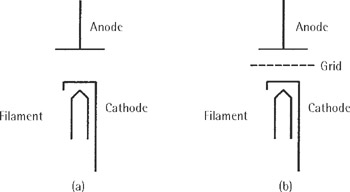
Look through any electronic books from the 1950s or 1960s, and you probably will see the symbols for vacuum tube devices. You also may wonder just what these things were and how they possibly could work. Figure 5.1 shows two types of vacuum tubes: the diode and the triode.
The diode tube has a filament and two elements: the cathode and the anode. The cathode is the source of electrons that are sent to the anode (sometimes called a plate). A diode operates as follows. An ac voltage (6.3V or 12.6V) is applied to the filament of the tube. (The...