Microwaves and Wireless Simplified, Second Edition
4.6: Attenuators

4.6 Attenuators

The term attenuate means to lessen the value of something. In RF and microwaves, attenuation is the lessening of the signal. Attenuating a signal in an electronic circuit is a matter of placing something in the path of the signal that will obstruct the signal's progress. That is fairly simple. However, to make an efficient attenuator that will operate as we would like it to requires that we not only attenuate the signal but maintain a good matched condition in the process. That is the measure of a good attenuator.

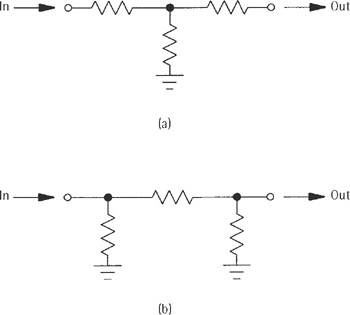
Different types of attenuators are used in RF and microwave applications. The fixed attenuator is probably the most common. Fixed attenuators are the components you see throughout a lab that are used for a variety of applications. Figure 4.30 shows two schematic representations that are used for fixed attenuators. Figure 4.30(a) is the T-type of attenuator, which has two series resistors and one shunt resistor. The ? attenuator in Figure 4.30(b) is just the opposite, two shunt resistors and a single series resistor in between. Both of these fixed attenuators are very good for a variety of applications and are common in a laboratory environment.


Figure 4.30: Fixed attenuators: (a) T attenuator and (b) ? attenuator.

The attenuators in Figure 4.30 can be used at a variety of frequencies. If your application is low frequency, a typical carbon resistor can be used. For higher frequency applications, ceramic chip resistors can be substituted for the carbon...

UNLIMITED FREE
ACCESS
TO THE WORLD'S BEST IDEAS

SUBMIT
Already a GlobalSpec user? Log in.

This is embarrasing...

An error occurred while processing the form. Please try again in a few minutes.

Customize Your GlobalSpec Experience

Category: RF Attenuators
Finish!
Privacy Policy

This is embarrasing...

An error occurred while processing the form. Please try again in a few minutes.