Microwaves and Wireless Simplified, Second Edition
4.4: Detectors

4.4 Detectors

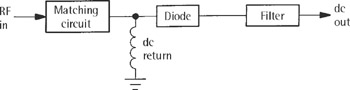
Probably the simplest and most useful RF and microwave component is the detector. You can see how basic the construction of the detector is by referring to Figure 4.19. The first block in the diagram is an input-matching circuit that is designed to match the diode impedance to the characteristic impedance of the system (usually 50 ?). A matching network is necessary so the maximum power can reach the diode and the conversion from RF to dc can take place efficiently. That matching network has the task of matching the complex impedance (a value of real resistance and a value of some sort of reactance, usually capacitive) to the real value of 50 ?, which is probably the characteristic impedance of the system driving the detector. Many times the network is a series of transmission lines of various lengths and widths that provide the necessary matching for the detector. This network allows the RF energy to be transferred efficiently to the diode so the detection process can occur. Without the matching network, a great deal of power would be lost between the input and the diode circuitry, and the detector would be a very inefficient device that would find few applications.


Figure 4.19: Detector.

The second block in Figure 4.19 is the diode itself (or a set of diodes) that actually performs the detection process. A detection process is one in which the full cycle of the RF input signal is clipped so that only the...

UNLIMITED FREE
ACCESS
TO THE WORLD'S BEST IDEAS

SUBMIT
Already a GlobalSpec user? Log in.

This is embarrasing...

An error occurred while processing the form. Please try again in a few minutes.

Customize Your GlobalSpec Experience

Category: RF Power Detectors
Finish!
Privacy Policy

This is embarrasing...

An error occurred while processing the form. Please try again in a few minutes.