Radar Foundations for Imaging and Advanced Concepts
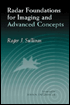
Whether you are a radar novice or experienced professional, this essential reference features the theory and practical application of formulas you use in radar design every day.
 TABLE OF CONTENTS
 The preceding chapters have devoted some detail to the fundamental aspects of radar: transmission/reception; antennas; waveforms; propagation; RCS; SNR; detection; and accuracy of measurement of range, velocity, and angular position. This chapter combines those fundamentals and considers the particular advantage of applying those techniques to the case of a rotating target, which leads us to the important domain of imaging radar.
Let us consider a stationary radar with constant beam direction observing a region for which we want to obtain the radar return as a function of both range and velocity versus time. As an example, assume the radar is on the shore facing the ocean. The radar is assumed to have a constant PRF (f R ) and to transmit a step-chirp waveform. That is, the radar transmits groups of N (N  1 ) monochromatic pulses; within a group, the frequency of a pulse is ? f greater than that of the previous pulse, and the radar transmits f R /N groups per second. Each pulse group has bandwidth B, and each pulse has pulse width ?. Within a pulse group, the frequency of individual pulse number n is given by

The A/D converter obtains one sample per returned pulse ( N samples per pulse group), and M groups ( M 1)...