Radar Foundations for Imaging and Advanced Concepts
Whether you are a radar novice or experienced professional, this essential reference features the theory and practical application of formulas you use in radar design every day.
 TABLE OF CONTENTS
 After the EM radiation leaves the radar antenna, it propagates into the external environment. Some of the radiation scatters from one or more objects in the environment, returns to the antenna, and enters the radar receiver. The radar may also receive some external noise simultaneously. This chapter discusses those effects.
The RCS of an object, denoted as ?, is given by [1]
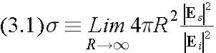
where E i is the incident electric field (a plane wave) and E s is the scattered electric field (a spherical wave as R ??). From Section 1.3, the average flux density S inc(W/m 2) incident on the target is

and the scattered flux density is

From Section 1.7, ? represents the scattered intensity in watts per steradian (sr). Thus,

Then
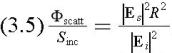
and, for R ??,
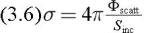
as discussed in Section 1.7.
The RCS has the dimensions of area and can be high or low with respect to the projected area of the target normal to the line of sight. The concept applies only if the radar and the target are in the far field with respect to each other.
It is useful to consider a spherical coordinate system fixed in the target (assumed to be a rigid body). The RCS is, in general, a strong function of azimuth and elevation in this coordinate system and a strong function of frequency and polarization as well.
The RCS of simple targets can be...