Radar Foundations for Imaging and Advanced Concepts
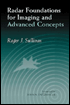
Whether you are a radar novice or experienced professional, this essential reference features the theory and practical application of formulas you use in radar design every day.
 TABLE OF CONTENTS
 A doppler radar is defined by [1] as a radar which uses the doppler effect to determine the radial component of relative radar target velocity or to select targets having particular radial velocities. A pulse-doppler (or pulsed-doppler) (PD) radar is defined [1] as a doppler radar that uses pulsed transmissions. PD radar is used extensively for detecting and characterizing moving targets.
A modern PD radar typically observes the scene in a particular direction during a CPI long enough to collect a number of pulses, digitally records the I and Q of each pulse (providing amplitude and phase information), and performs an FT (see Section 2.1) of the complex returns, yielding the (doppler) frequency spectrum of the echoes, from which the LOS velocity spectrum can be determined.
This chapter considers monochromatic pulses, that is, those pulses formed by multiplying a single-frequency tone with a rectangular envelope of duration ?, with the resulting bandwidth B ?1/ ?. If modulated pulses and pulse compression (PC) are used, the PC is performed on each pulse as soon as it is received, and the doppler processing is performed for each range bin of interest.
We assume that the radar receives a sequence of pulses scattered from a point target. The pulses are assumed to have been transmitted with a constant PRF f R and therefore constant...