Signal Processing: A Mathematical Approach

A practical guide to the mathematics behind signal processing, this book provides the essential mathematical background and tools necessary to understand and employ signal processing techniques.
 TABLE OF CONTENTS
 In this chapter we review a few important results from the theory of probability that will be needed later.
Let X 1 , , X N be N independent real random variables with the same mean (that is, expected value) ? and same variance ? 2. The main consequence of independence is that E( X i X j) = E( X i) E( X j) = ? 2 for i ? j. Then, it is easily shown that the sample average
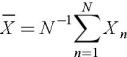
has ? for its mean and ? 2 /N for its variance.
Exercise 39.1. Prove these two assertions.
Suppose that the random variable X has a probability density function p( x; ?), where ? is an unknown parameter. A common problem in statistics is to estimate ? from independently sampled values of X, say x 1 , , x N. A frequently used approach is to maximize the function of ? given by

The function L( ?) is the likelihood function and a value of ? maximizing L( ?) is a maximum likelihood estimate. We give two examples of maximum likelihood (ML) estimation.