Signal Processing: A Mathematical Approach

A practical guide to the mathematics behind signal processing, this book provides the essential mathematical background and tools necessary to understand and employ signal processing techniques.
 TABLE OF CONTENTS
 A square matrix A is said to have inverse A ?1 provided that

where I is the identity matrix. The 2 by 2 matrix  has an inverse
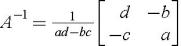
whenever the determinant of A, det( A) = ad ? bc, is not zero. More generally, associated with every complex square matrix is the complex number called its determinant, which is obtained from the entries of the matrix using formulas that can be found in any text on linear algebra. The significance of the determinant is that the matrix is invertible if and only if its determinant is not zero. This is of more theoretical than practical importance, since no computer can tell when a number is precisely zero. A matrix A that is not square cannot have an inverse, but does have a pseudo-inverse, which is found using the singular-value decomposition.
Suppose that A x = b is a consistent linear system of M equations in N unknowns, where M < N. Then there are infinitely many solutions. A standard procedure in such cases is to find that solution x having the smallest norm
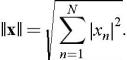
As we shall see shortly, the minimum norm solution of A x = b is a vector of the form x = A z