Signal Processing: A Mathematical Approach

A practical guide to the mathematics behind signal processing, this book provides the essential mathematical background and tools necessary to understand and employ signal processing techniques.
 TABLE OF CONTENTS
 Previously we studied the problem of isolating the individual complex exponential components of the signal function s( t), given the data vector d with entries s( m ?) , m = 1, , M, where s( t) is
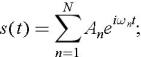
we assume that ? n < ?/ ?. The second approach we considered involved calculating the function
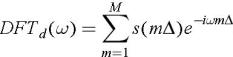
for ? < ?/ ?. This sum is an example of a (finite) Fourier series. As we just saw, we can extend the concept of Fourier series to include infinite sums. In fact, we can generalize to summing over a continuous variable, using integrals in place of summation; this is what is done in the definition of the Fourier transform.
In our discussion of linear filtering, we saw that if f is a finite vector f = ( f 1 , , f M ) T or an infinite sequence  , then it is convenient to consider the function F( ?) defined for ? ? ? by the finite or infinite Fourier series expression

If f( x) is a function of the...