The Importance of Thread Pitch
Featured Product from APM Hexseal Corp.
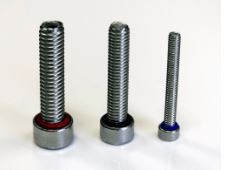
The Importance of Thread Pitch and How to Select the Right Fastener for Secure and Reliable Connections
Thread pitch is one of the fundamental characteristics of screw design. Pitch directly affects the holding power and integrity of threaded assemblies. It is the key to pairing a screw or bolt with a compatible nut and ensuring smooth installation.
Whether you’re working with an automotive, aerospace, or any other application that relies on secure fasteners, selecting the correct thread pitch is critical to avoiding issues like loosening, misalignment of components, premature damage, or mechanical failure.
Here, we’ll go over what thread pitch is and how to select the right pitch for your needs.
So What is Thread Pitch on a Screw?
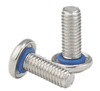
Holding a screw horizontally, it’s easy to see the peaks and valleys of its profile. The distance between two consecutive peaks is called the pitch, and it represents the distance the screw travels per 360° revolution.
This measurement directly reflects how well the screw or bolt will engage with a corresponding nut or threaded hole. A mismatched pitch between two corresponding fasteners may prevent a screw from engaging, or cause locking or breakage, which compromise the entire assembly.
Generally speaking, the smaller the distance between thread peaks the more fine the threads are. Thread pitch is generally categorized as standard, fine, or extra fine. The finer the pitch, the closer the threads are to each other, which influences how the screw performs under different conditions.
Different screw sizes are often available in a range of pitches. For example, an M12-size screw may have a standard pitch of 1.75mm, a fine pitch of 1.5mm, and an extra fine pitch of 1.25mm.