When Should Hydraulic Cooling Go Off-Line?
Featured Product from jbj Techniques Limited
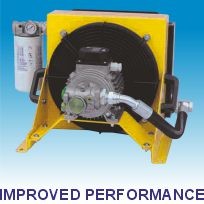
Pressure spikes or high return flows can make the main hydraulic return line unsuitable for a heat exchanger. An off-line air blast cooler provides a separate route for circulating and cooling the oil.
The GA series supplied by jbj Techniques combines an aluminium heat exchanger, an electric motor, a gear pump and a fan. The pump circulates oil through a dedicated cooling loop, while the fan moves air across the heat exchanger to remove heat.
Why use a separate cooling circuit?
The cooler’s oil flow is provided by its own pump. This allows cooling circulation to be selected separately from the main circuit’s return flow, with the heat exchanger installed in a dedicated loop.
This arrangement is worth considering where:
» Pressure spikes make return-line cooling unsuitable.
» Main circuit return flows exceed the requirements or limits of the proposed cooler.
» The installation calls for a separate oil cooling loop.
What does the GA range offer?
The catalogue lists model-dependent oil flows from 9 to 440 litres/min and cooling capacities from 4.8 to 148.8 kW at a stated temperature difference of 40°C.
Those capacities are tied to the catalogue’s rating conditions. Selecting a unit requires the actual heat load, required oil temperature and ambient air temperature, together with the appropriate oil flow.
Make room for the air as well as the cooler
Available installation space, a clear cooling-air path, pipework connections and access for cleaning all deserve consideration. The unit also needs a suitable electrical supply and an oil circuit designed within its operating limits.
Share your hydraulic operating conditions, cooling requirement and installation details with jbj Techniques for help selecting a suitable configuration.
View GA series specifications and model options:
https://www.jbj.co.uk/e-publications/Coolers-Heat-Exchangers/82/index.html