Industrial Cooling: Five Selection Checks
Featured Product from jbj Techniques Limited
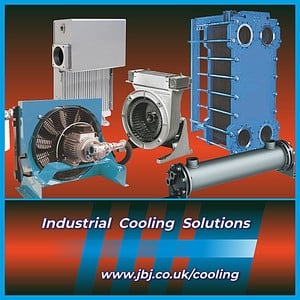
Choosing a cooler involves more than finding a unit with a suitable kW rating. Its ability to remove heat depends on the temperatures, flow rates and conditions within the installation.
Whether you are designing a new machine or investigating an existing cooling problem, five checks help establish what the equipment needs to do.
1. How much heat must be removed?
Establish the heat load under the relevant operating conditions. The power rating of the machine or its drive is not automatically the amount of heat the cooler must dissipate. The assessment needs to consider the losses that become heat and the machine’s operating cycle.
2. What fluid is being cooled, and at what flow?
Identify the fluid, its viscosity at operating temperature and the flow through the cooler. These influence heat transfer and pressure drop. The cooler’s materials, seals and pressure capability must also suit the circuit.
3. What temperatures must the system achieve?
Specify the required fluid temperature and the temperature of the available cooling air or water. The temperature difference affects cooling capacity, so catalogue ratings must be checked against their stated conditions.
A cooler rated at a temperature difference of 40°C will not provide that same capacity when the available difference is smaller.
4. What cooling medium and operating environment are available?
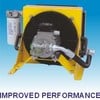
Air blast cooling and water-cooled heat exchangers suit different installations. Consider the available air or water supply, ambient temperature, contamination and corrosion exposure. Marine or hazardous-area applications can introduce further specification requirements.
5. How will the cooler fit and be maintained?
Check the available space, mounting arrangement, connections and access for cleaning. Air blast units need a clear airflow path, while water-cooled equipment needs a suitable cooling-water supply. Pipework and fan drive requirements also belong in the assessment.
Turn the operating details into a suitable selection
jbj Techniques supplies hydraulic oil coolers, shell-and-tube and plate heat exchangers, and combined cooling packages, with support for sizing and configuration.
Share your heat load, fluid and flow details, required temperatures and installation constraints with jbj. If some information is missing, we can help identify what is needed to progress the selection.
Explore industrial cooling and heat exchange options:
https://www.jbj.co.uk/cooling-heatexchange.html